CITES and the international plant trade
By: Dr Noeleen Smyth, Guy Clarke, Sonia Dhanda, China Williams, Stuart Cable, Helene Ralimanana, Rose Simpson, Royal Botanic Gardens, Kew
Trade in rare species shows no signs of abating. In 2014, the Convention on International Trade in Endangered Species (CITES) regulated plant trade (2320 plant taxa) imported into the EU was worth $286 million (UNEP-WCMC 2016). As a result of CITES COP17 an additional 304 species have been added to the over 31,517 plant species that are currently listed on the CITES Appendices.
Which are the most common plant families listed on CITES?
There are 60 plant families with species listed on the CITES Appendices ranging from well-known families such as Orchids, Cacti, Cycads to Didiereas which is an unusual family of spiny succulents from Madagascar and Africa. The second largest plant family in the world after the daisy family, the orchid family (Orchidaceae), dominates the listings on the CITES Appendices (84%).
The desire for and interest in these “luxury plants” has led to the coining of “orchid mania.” Their appeal attracts thousands of visitors to Kew’s orchid festival every year (Willis & Fry 2015), while orchids for sale as cut flowers and pot plants is a trade worth millions of pounds (USDA 2015). Over 39 species of orchids in European trade appear as components of cosmetic, food and medicinal products (Brinckmann, 2014). An interesting documented social use exists for one orchid Ansellia africana which is used as a love charm, as an antidote for bad dreams and to ward off lightning (Crook, 2013). It is also highly collected and consequently has an IUCN Red List assessment status of Vulnerable. Another unusual use of orchids is in tea. Historically, Bourbon tea was made from the epiphytic orchid Jumellea fragrans, found on the islands of Reunion (formerly known as Bourbon) and Mauritius. This beverage was highly popular 80–100 years ago (Pridgeon et al., 2014).
The next largest family group listed on the CITES Appendices is Cactaceae (CITES, 2015), with 1,898 species. More than half of all cactus species are estimated to be used by people. The most common stated use is ornamental horticulture (Goettsch et al., 2015) but food is another; for example prickly pear (Opuntia spp.) is commonly used as food (Global Invasive Species Database, 2015). Matching the CITES Appendices checklist (CITES, 2015) of cacti species against Kew databases (WCSP, 2017) reveals there are currently 231 cacti species with uses. These include species with medicinal uses (65 spp.), environmental uses (152 spp.) and social uses (10 spp.), in addition to animal food (29 spp.), human food (89 spp.), materials (43 spp.), fuels (11 spp.), gene sources (9 spp.), poisons (4 spp.) and even invertebrate food (1 spp.). Our world would have a lot less colour without Dactylopius coccus, a scale insect which feeds on Opuntia and from which the natural red dye carmine or cochineal was first derived, used and discovered by the Aztec and Mayan civilisations (Nobel, 2002). The dye has become popular again, as many commercial synthetic red dyes have been found to be carcinogenic (Schiebinger, 2007).
How well is CITES doing in terms of combatting illegal plant trade?
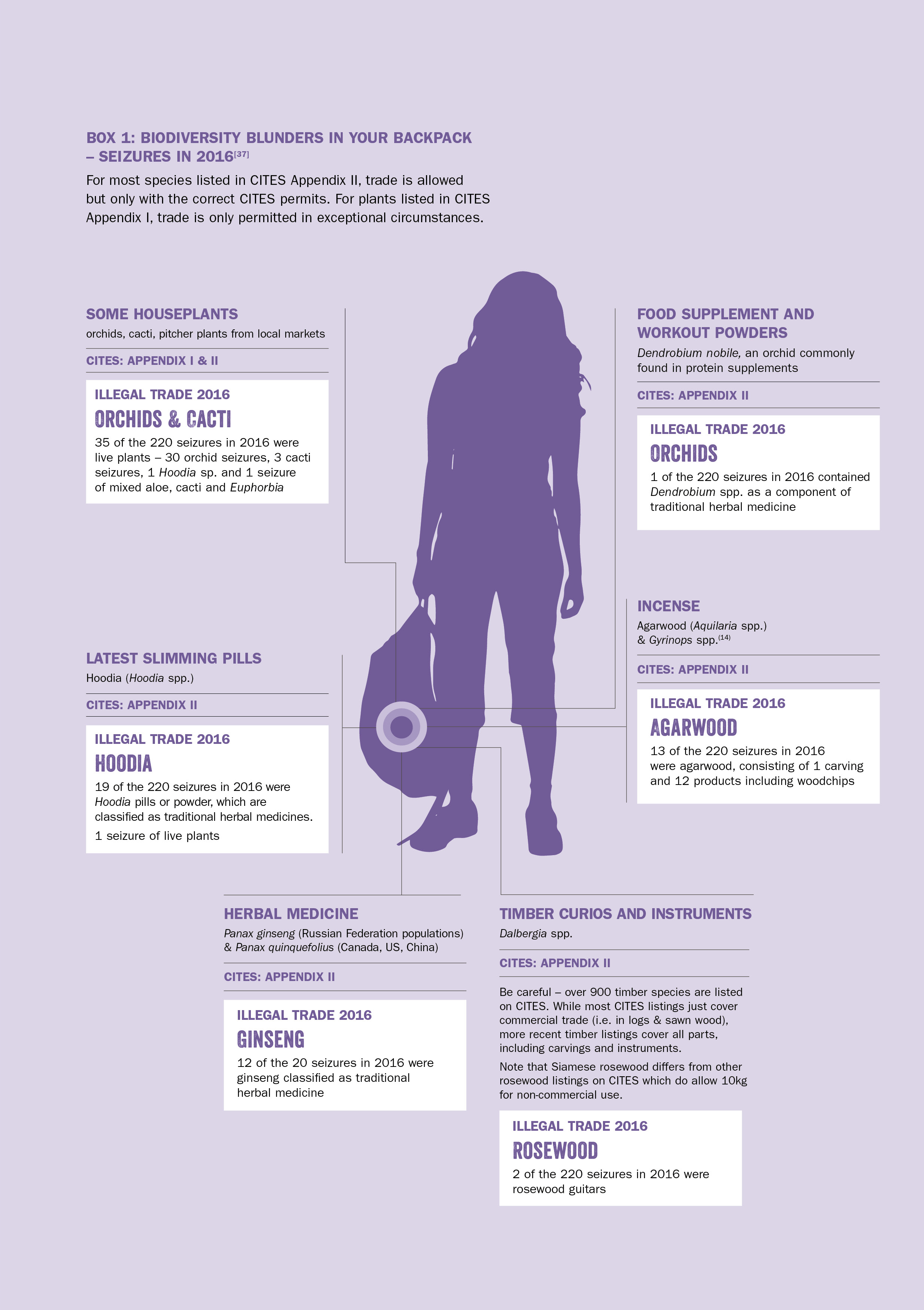
This issue is difficult to fully assess globally but as a snapshot of trade in illegal plants in the UK we obtained data of plant seizures in 2016 by UK Borderforce at Heathrow Airport, London. This revealed 220 individual CITES plant related seizures were made in 2016. Live orchid plants dominate the seizures, followed by plants used in traditional and healthcare medicines. This pattern is similar to other studies indicating that the illegal trade in plants, the world over, is dominated by orchids (Hinsley et. al 2015 & 2016, Lavorgna, 2014, Phelps, 2015 & SOTWP Kew 2016).
A key question, however, is why this illegal trade in plants is occurring. Whilst there is an internet-driven trade in wild plant species, especially for the horticulture industry (Hinsley et. al 2015 & 2016; Vaglica et. al., 2017), many incidents of illegal plant materials seized at Heathrow show that often the passenger is unaware of the legislation and protection surrounding CITES listed species and products (see infographic, Biodiversity Blunders in your Backpack). This indicates an urgent need for better education for travellers especially those visiting some of the most plant biodiverse regions in the world.
Read the full chapter in the State of the World’s Plant Report here.
Article edited by: Nafeesa Esmail