Oxford Martin Programme on the Wildlife Trade
  • Link to X
  • Link to Youtube
  • Link to Flickr
  • Home
  • About
    • Team
    • Advisory Committees
    • Collaborators
    • Sponsors
    • Reports
    • Contact Us
  • Research
    • Frameworks, approaches and methods
    • Case studies
    • Research Articles
  • Events
    • Upcoming Events
    • Past Events
      • 2018 IWT Event
      • 2017 Symposium
  • Resources
  • Trading Ideas
  • Menu Menu

Trading Ideas

Medicinal Trade of Reptiles in Morocco

August 31, 2017

By: Daniel Bergin & Vincent Nijman, Researchers, Oxford Wildlife Trade Research Group, Oxford Brookes University
  • Credit: Daniel Bergin

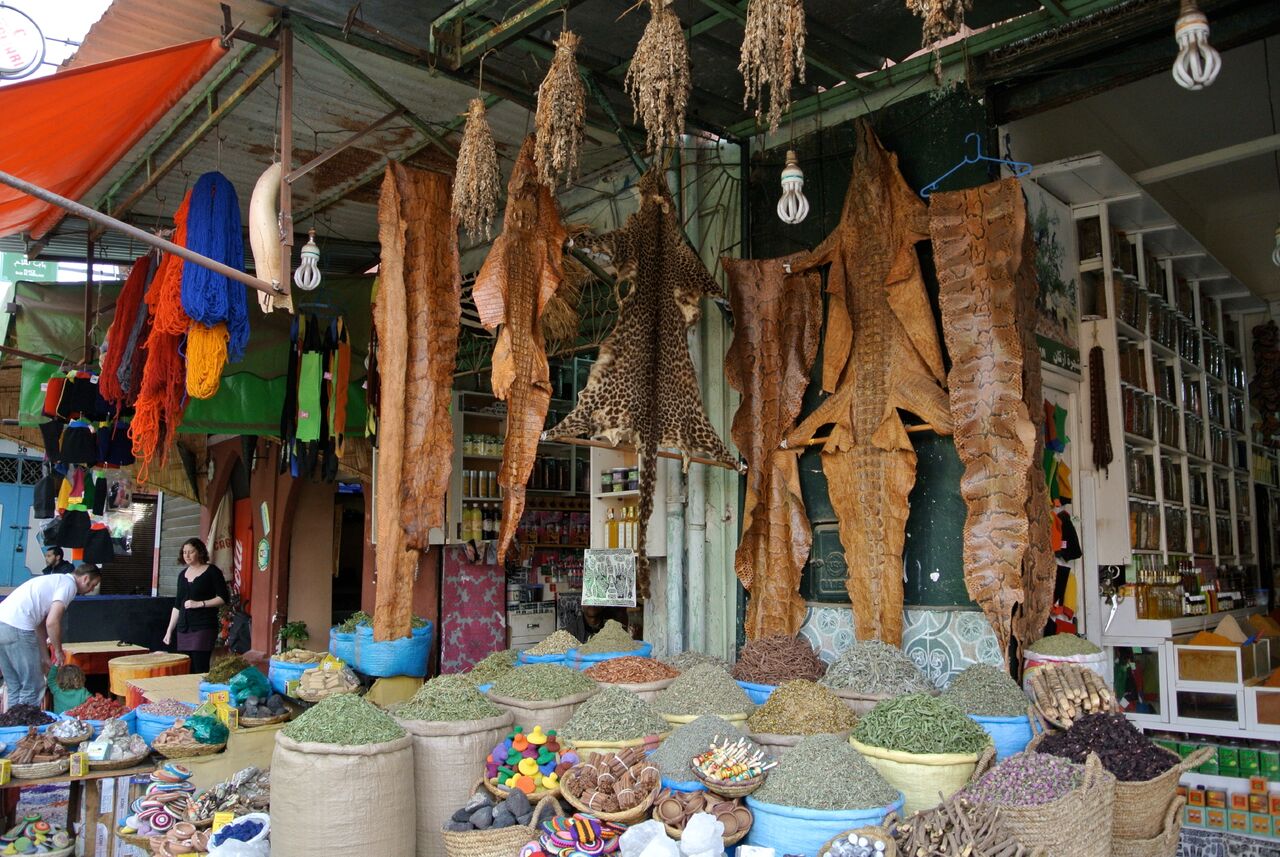
In many of the thousands of shops that line the streets of Morocco’s medinas, buyers can find anything from traditional Berber carpets to smartphones. One type of shop, “herbalists” specialise in herbs, spices, oils and traditional medicines. Reptiles and their parts are often found in these shops, a practice persisting from Morocco’s historic past. Accounts of the traditional medicines of Morocco date back as far as 1810 – James Grey Jackson described, in colourful language, the practice of burning chameleons:

“Various medicinal qualities are assigned to the flesh of the chameleon; and many whimsical effects are attributed to fumigation with it when dried. Debilitated persons have recourses to it, and it is accordingly sold in all the drug shops at Morocco [present day Marrakesh], Fas [Fez], and other places. The smell arising from the fumigation is by no means grateful; but what scent will prevent an African from using that remedy which credulity or superstition has persuaded him will give strength to the impotent!”

Despite this, and other more recent accounts, no previous studies have quantified the number of animals used in Morocco for medicinal purposes. To investigate trade of reptiles for medicinal practices, our study carried out 49 surveys of 20 towns and cities in Morocco, as well as the two Spanish cities of Ceuta and Melilla – the only European cities located on the African mainland. We noted the presence of any wild species found in markets and, where possible, gathered information on their uses, turnover and origins.

We recorded more than 1,500 specimens of at least 9 reptile species in 14 cities and towns. Marrakech and Casablanca contained the most specimens with an average of 163 and 86 per survey in each city, respectively. The specimens observed, together represent in the region of USD 100,000 worth of goods. The most commonly observed animals were Mediterranean chameleons and Bell’s dabb lizards, sold both live and taxidermal. Traditional applications of wildlife in Morocco combine cultural, mystic and medical uses. The uses of animals were reported as varied, but reflect the traditional uses of the past. Chameleons were mostly sold dried and perceived to protect from a range of ailments, from headaches to the evil eye (a look from a person that is supposed to invoke a curse or bad luck). Stuffed bell’s dabb lizards are placed under the corner of a new house to bring luck or can be burned to help with eye irritation.

Morocco has recently brought in national legislation to protect wildlife from overexploitation, with fines of up to USD 10,000 for trade of any species within the highest category of protection (e.g. species included on CITES Appendix I) according to Law n°29-05 on the Protection of Species of Flora and Fauna and the Control of their Trade. Despite these new laws the trade has not diminished over time, nor has the openness of the trade. Reptiles are still sold openly and throughout the country. With this information, we intend to lobby the government to better enforce national wildlife trade laws in hopes that Moroccan authorities will use these new laws to curb the unregulated trade of reptiles in markets. We are also planning to expand our research to Algeria and Tunisia, building a more thorough regional ethnopharmelogical study on the uses of reptiles and other species in medicine.

More information can be found here


Article edited by: Nafeesa Esmail

Share this entry
  • Share on Facebook
  • Share on X
  • Share on WhatsApp
  • Share on Pinterest
  • Share on LinkedIn
  • Share on Reddit
https://illegalwildlifetrade.net/wp-content/uploads/2017/08/1-African-rock-python-and-Nile-crocodile-skins-Marrakesh_crop.jpg 250 400 symposium http://illegalwildlifetrade.net/wp-content/uploads/2021/02/Logo_w_Strap_HoriztonalOMS-logo.png symposium2017-08-31 11:45:082019-11-29 14:05:52Medicinal Trade of Reptiles in Morocco

Questions, feedback or want to trade your ideas?

Contact us

Recent Articles

  • Reflecting on wildlife trade researchAugust 6, 2021 - 10:24 am
  • Characterising wild meat consumers in Vietnam visual abstract. Credit: Alegria OlmedoAlegria Olmedo
    Characterising wild meat consumers in VietnamApril 30, 2021 - 12:20 pm
  • Conservation litigation could help tackle illegal wildlife tradeApril 22, 2021 - 4:05 pm
  • Jaguar. Credit: Melissa AriasMelissa Arias
    Complex interactions between commercial and noncommercial drivers of illegal trade for a threatened felidMarch 19, 2021 - 10:51 am
  • On the IWT horizon: Reshaping Africa’s role of wildlife trade and its relationship between economic systems and natureJuly 28, 2020 - 9:00 am
  • On the IWT horizon: Social Media – an emerging marketplace for ideas, (mis)information, and illegal wildlife tradeJune 5, 2020 - 8:20 am
  • On the IWT horizon: Species discoveries and descriptions that fuel wildlife traffickingMay 26, 2020 - 10:00 am
  • Haiwei store in Hong KongJ. Lam
    On the IWT horizon: Haiwei—Identifying the connection between a global demand for dried seafood and marine conservationMay 14, 2020 - 11:07 am
  • Proactive engagement with wildlife trade issues in an unsettled worldMay 12, 2020 - 11:50 am
  • OMP-WT
    What are the origins of novel human infectious diseases like COVID-19?May 5, 2020 - 1:45 pm
  • Position statement: managing wildlife trade in the context of COVID-19 and future zoonotic pandemicsApril 15, 2020 - 1:52 pm
  • Women at the Moutuka Nunene bushmeat market in Lukolela, Democratic Republic of Congo. Photo by Ollivier Girard/CIFOR
    The COVID-19 response and wild meat: a call for local contextApril 8, 2020 - 1:53 pm
  • A fish market in Seoul, South Korea. Rodrigo OyanedelOMP-WT
    Coronavirus: why a blanket ban on wildlife trade would not be the right responseApril 8, 2020 - 12:00 pm
  • Woman standing by a pound
    On COVID-19, and rebalancing our relationship with natureApril 3, 2020 - 2:04 pm
  • Menu of a wild meat restaurant in Wuhan Huanan seafood market, where civet, bamboo rat and other animals were sold. Photo credit: weiboOMP-WT
    China’s Announcement on Wildlife Trade – What’s New and What Does It Mean?February 28, 2020 - 2:17 pm
  • S. Romañach
    Targeting wildlife crime interventions through geographic profilingOctober 28, 2019 - 11:58 am
  • J. Onoja
    Is the demand for vulture parts in Nigeria affecting regional vulture populations?October 28, 2019 - 11:57 am
  • A. K. Y. Wan
    Illegal international trade in seahorses continues despite CITES regulationsOctober 28, 2019 - 11:56 am

Join & Contact us

11a Mansfield Rd
Oxford OX1 3SZ

info@illegalwildlifetrade.net

Twitter feed is not available at the moment.
OMS Logo ICCS Logo Oxford Internet Institute Logo
© Copyright - Oxford Martin Programme on the Wildlife Trade, University of Oxford
  • Link to X
  • Link to Youtube
  • Link to Flickr
  • Privacy Policy
  • Mailing List Privacy
  • Cookie Policy
Link to: Effectiveness of Celebrities in Conservation Marketing Link to: Effectiveness of Celebrities in Conservation Marketing Effectiveness of Celebrities in Conservation Marketing Link to: By-catch, the Dark Web and the demise of AlphaBay Link to: By-catch, the Dark Web and the demise of AlphaBay By-catch, the Dark Web and the demise of AlphaBay
Scroll to top Scroll to top Scroll to top
We use cookies to ensure that we give you the best experience on our website. If you continue to use this site we will assume that you are happy with it.