Oxford Martin Programme on the Wildlife Trade
  • Link to X
  • Link to Youtube
  • Link to Flickr
  • Home
  • About
    • Team
    • Advisory Committees
    • Collaborators
    • Sponsors
    • Reports
    • Contact Us
  • Research
    • Frameworks, approaches and methods
    • Case studies
    • Research Articles
  • Events
    • Upcoming Events
    • Past Events
      • 2018 IWT Event
      • 2017 Symposium
  • Resources
  • Trading Ideas
  • Menu Menu

Trading Ideas

Understanding complexities of the world’s biggest shark and ray fishery
April 26, 2017
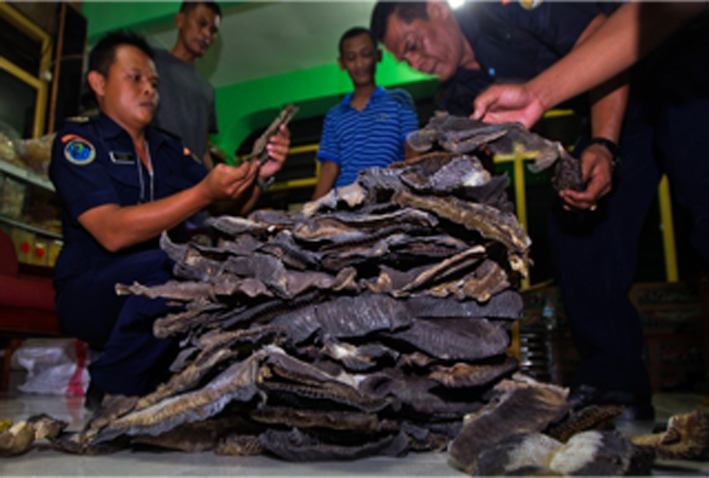
  • Credit: Paul Hilton for WCS

By: Hollie Booth, Sharks and Rays Advisor, South East Asia, Wildlife Conservation Society


Komodo National Park in western East Nusa Tenggara province, Indonesia, attracts tourists from all over the world to experience world-class scuba diving. Luscious reefs and tumultuous currents create a diverse, breath-taking environment, home to healthy populations of charismatic marine megafauna. Dive tourists are almost guaranteed to get up-close and personal with several shark and ray species, but it’s the 4m wide manta rays, soaring across the shallow, sandy banks of ‘manta point’, that are the biggest attraction. O’Malley et al., (2013) estimated tourists to spend over 10 million USD/year on diving with manta rays in Indonesia.

Approximately 500km east of Komodo National Park, in the fishing village of Lamakera, manta rays hold a completely different value. Lamakera is a relatively isolated, underdeveloped corner of the archipelago, where access to employment opportunities and infrastructure is limited, and with peak annual landings of up to 2,400 individuals in the early 2000’s, it is considered the world’s top manta ray hunting location. Small-scale manta ray fishing has operated in Lamakera for centuries, providing a source of sustenance and trade for the community, but growth and modernisation of fishing fleets coupled with a surge in demand for manta ray gills in Traditional Chinese Medicine markets has led to dramatic intensification of manta ray exploitation for commercial trade. Mantas are slow-growing and long-lived, making them highly vulnerable to overexploitation, and annual catch in Lamakera has been gradually declining since the early 2000’s, despite increases in fishing effort, indicating a population crash.

The stark contrast between these two sites within the same province in Indonesia illustrates the diversity of use and value of sharks and rays in Indonesia; the influential role globalisation and international markets play in shaping our relationships with nature; and the complexities and trade-offs involved in delivering conservation solutions. Recognising this, the Wildlife Conservation Society (WCS) is working to support shark and ray conservation in Indonesia through a multi-faceted approach from policy, regulation and law enforcement to outreach and livelihood-focused interventions.

Specifically for manta rays, WCS assisted the Indonesian government to develop a ministerial decree to protect manta rays throughout the entire country in 2014, which has been followed by support for enforcement of this decree by investigating and arresting traders in illegal manta ray products, and dismantling illegal trade syndicates; working with partners to develop options for livelihood diversification in manta fishing communities; and monitoring changes in trade and exploitation to assess the impact of regulation and enforcement. Preliminary impact assessment results suggest the regulation is influencing manta ray exploitation rates in at least one site where socialisation and enforcement has been clear and consistent, but the nature and magnitude of the country-wide impact is not yet clear (Booth et al. 2016). Perhaps more importantly, this process is revealing valuable lessons in the challenges of implementing, monitoring and evaluating wildlife protection regulations in dynamic and complex contexts. In particular, there is no ‘one size fits all’ approach: effective shark and ray conservation requires multiple interventions, adapted to the motivations and interests of local groups and circumstances.

Moving forward, WCS is working with government and research partners to develop integrated data collection systems for understanding the magnitude of exploitation and trade of all shark and ray species throughout Indonesia. In partnership with the Oxford Martin Programme on the Illegal Wildlife Trade, as a new case study researchers will explore:

  • What is the magnitude of illegal shark and ray trade in Indonesia, and how has illegal trade changed as a result of law enforcement?
  • Who are the key consumers of shark and ray products, in Indonesia and internationally?
  • What are consumer characteristics and motivations, and how can we design behaviour change interventions to encourage responsible consumption?  

Research outputs will be used to inform the design, evaluation and adaptation of practical conservation measures to encourage responsible consumption of sharks and rays, which we hope will contribute to restoring healthy populations of sharks and rays, which can deliver both ecological and socioeconomic benefits for Indonesia.

See here for more information on WCS Indonesia and our other conservation programs.


Article edited by: Nafeesa Esmail

Share this entry
  • Share on Facebook
  • Share on X
  • Share on WhatsApp
  • Share on Pinterest
  • Share on LinkedIn
  • Share on Reddit
https://illegalwildlifetrade.net/wp-content/uploads/2017/07/Manta-ray-gills_P.Hilton-1-e1501159590546.jpg 249 400 symposium http://illegalwildlifetrade.net/wp-content/uploads/2021/02/Logo_w_Strap_HoriztonalOMS-logo.png symposium2017-04-26 10:30:542019-11-29 14:08:08Understanding complexities of the world’s biggest shark and ray fishery
You might also like
Probing the Elephant in the Room
How do we Understand Illegal Wildlife Trade?
Wildlife Trafficking and Security: Myths and Realities
Conservation litigation could help tackle illegal wildlife trade
The power of supportive collaborative efforts, capacity building and local involvement
Semi-intensive rhino breeding operation in South Africa Taking Stock of Stockpiles
Jaguar. Credit: Melissa AriasMelissa Arias Complex interactions between commercial and noncommercial drivers of illegal trade for a threatened felid

Questions, feedback or want to trade your ideas?

Contact us

Recent Articles

  • Reflecting on wildlife trade researchAugust 6, 2021 - 10:24 am
  • Characterising wild meat consumers in Vietnam visual abstract. Credit: Alegria OlmedoAlegria Olmedo
    Characterising wild meat consumers in VietnamApril 30, 2021 - 12:20 pm
  • Conservation litigation could help tackle illegal wildlife tradeApril 22, 2021 - 4:05 pm
  • Jaguar. Credit: Melissa AriasMelissa Arias
    Complex interactions between commercial and noncommercial drivers of illegal trade for a threatened felidMarch 19, 2021 - 10:51 am
  • On the IWT horizon: Reshaping Africa’s role of wildlife trade and its relationship between economic systems and natureJuly 28, 2020 - 9:00 am
  • On the IWT horizon: Social Media – an emerging marketplace for ideas, (mis)information, and illegal wildlife tradeJune 5, 2020 - 8:20 am
  • On the IWT horizon: Species discoveries and descriptions that fuel wildlife traffickingMay 26, 2020 - 10:00 am
  • Haiwei store in Hong KongJ. Lam
    On the IWT horizon: Haiwei—Identifying the connection between a global demand for dried seafood and marine conservationMay 14, 2020 - 11:07 am
  • Proactive engagement with wildlife trade issues in an unsettled worldMay 12, 2020 - 11:50 am
  • OMP-WT
    What are the origins of novel human infectious diseases like COVID-19?May 5, 2020 - 1:45 pm
  • Position statement: managing wildlife trade in the context of COVID-19 and future zoonotic pandemicsApril 15, 2020 - 1:52 pm
  • Women at the Moutuka Nunene bushmeat market in Lukolela, Democratic Republic of Congo. Photo by Ollivier Girard/CIFOR
    The COVID-19 response and wild meat: a call for local contextApril 8, 2020 - 1:53 pm
  • A fish market in Seoul, South Korea. Rodrigo OyanedelOMP-WT
    Coronavirus: why a blanket ban on wildlife trade would not be the right responseApril 8, 2020 - 12:00 pm
  • Woman standing by a pound
    On COVID-19, and rebalancing our relationship with natureApril 3, 2020 - 2:04 pm
  • Menu of a wild meat restaurant in Wuhan Huanan seafood market, where civet, bamboo rat and other animals were sold. Photo credit: weiboOMP-WT
    China’s Announcement on Wildlife Trade – What’s New and What Does It Mean?February 28, 2020 - 2:17 pm
  • S. Romañach
    Targeting wildlife crime interventions through geographic profilingOctober 28, 2019 - 11:58 am
  • J. Onoja
    Is the demand for vulture parts in Nigeria affecting regional vulture populations?October 28, 2019 - 11:57 am
  • A. K. Y. Wan
    Illegal international trade in seahorses continues despite CITES regulationsOctober 28, 2019 - 11:56 am

Join & Contact us

11a Mansfield Rd
Oxford OX1 3SZ

info@illegalwildlifetrade.net

Twitter feed is not available at the moment.
OMS Logo ICCS Logo Oxford Internet Institute Logo
© Copyright - Oxford Martin Programme on the Wildlife Trade, University of Oxford
  • Link to X
  • Link to Youtube
  • Link to Flickr
  • Privacy Policy
  • Mailing List Privacy
  • Cookie Policy
Link to: The power of supportive collaborative efforts, capacity building and local involvement Link to: The power of supportive collaborative efforts, capacity building and local involvement The power of supportive collaborative efforts, capacity building and local ... Link to: Wildlife Trafficking and Security: Myths and Realities Link to: Wildlife Trafficking and Security: Myths and Realities Wildlife Trafficking and Security: Myths and Realities
Scroll to top Scroll to top Scroll to top
We use cookies to ensure that we give you the best experience on our website. If you continue to use this site we will assume that you are happy with it.